

Cart
0
When hay is not enough to meet needs
The horse is a grazing herbivore, but in most cases it lives in box and feeds on preserved hay rather than fresh pasture. This raises questions about the quality and suitability of these preserved forages, considering production, nutritional content, digestibility, hygiene and quantity fed. Especially for performance horses, forages are often replaced with energy-dense feeds, which may result in a reduction in the proportion of forage-based diet. This negatively affects the horse's wellbeing, behaviour and even performance.

Hay in the horse's diet and requirements
Hay constitutes the largest proportion of the equine diet (2% of the horse's weight, on dry matter) and often provides most of the nutrients required to cover the horses' needs. However, forages alone may not be able to meet the full requirements of amino acids, minerals and vitamins of horses, particularly broodmares and foals, young horses and sporting subjects. This is why the choice of hay must be anything but random, but oriented to the needs of the horse for which it is intended.
What kind of hay is fed to horses?
In principle, forages can be divided into 3 categories: cold season forages, warm season forages and legume forages. Each of these forage categories has unique characteristics in terms of calories, protein, amino acids, carbohydrate fractions and anti-nutritional factors, which lend themselves to a specific purpose in equine nutrition

Cool-season hays include cereal forage crops such as oats, wheat, rye and barley, as well as perennial and annual grazing species such as fescue and ryegrass. They generally have a higher energy and protein content at a stage of maturity comparable to warm-season grasses. However, it is the maturity of the forage at the time of grazing or harvest for stored forage that will determine the final caloric value.
Warm-season plants can accumulate high levels of crude protein (20%), as opposed to cold-season plants, which contain about 7%, but the amino acid pool is still of lower quality than alfalfa (legumes), lysine being in very low concentrations.

Leguminous plants generally have a higher calcium and magnesium content than grasses, making them useful in the diet of growing horses and mares. However, this high mineral content, combined with the high protein content, may also predispose horses to the formation of intestinal enteroliths (struvite stones). The high calcium content makes the ration more alkaline, exerting a beneficial buffering effect on gastric pH.
The concentration of NSC (starch + sugars + fructans) can be as high as 40% dry matter under the right environmental conditions. Among cold season plants, ryegrass is potentially particularly problematic for equines requiring a low NSC diet such as obese or insulin dysregulated horses or sport horses with particular muscle problems. NSC concentrations can be highly variable from day to day and even within a day in the same pasture.
Can straw be used as fodder?
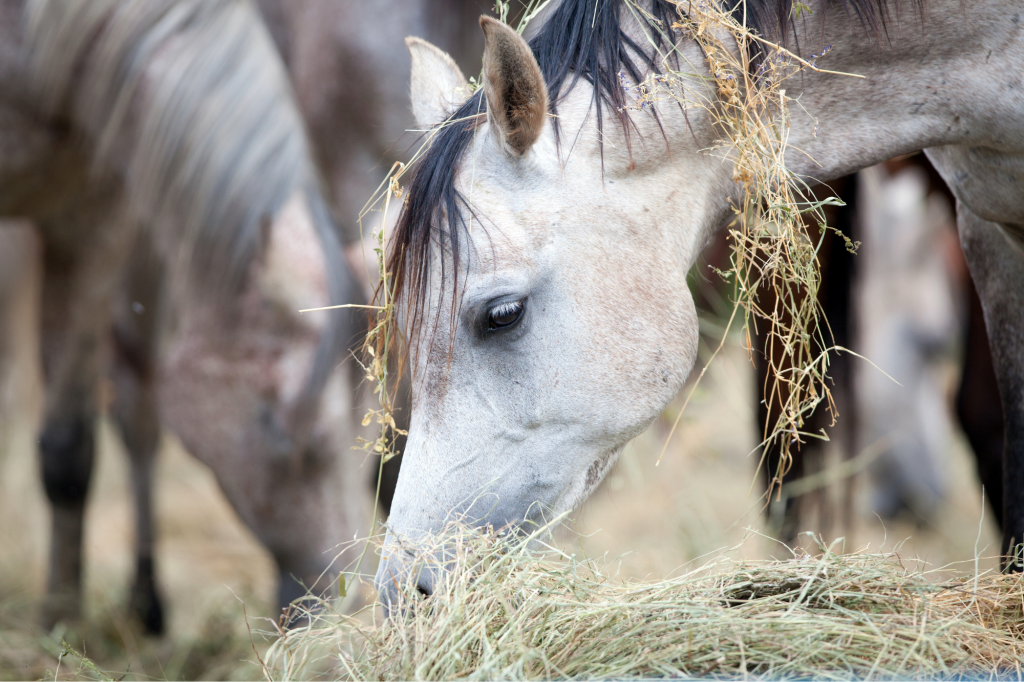
Straw predisposes to constipation, so it should be used with caution. Care must also be taken to provide a balanced diet when feeding straw or other low-quality fodder. Straw, as the only fodder, is also not recommended at all due to the potential increased risk of gastric ulceration.
Is fodder analysis necessary?

It is not common practice to buy hay with accompanying analysis, but it should become a good habit to request it from the producer or trader. Forage analysis allows you to design rations that adequately meet requirements and to choose to avoid hay whose anti-nutritional factors can affect its quality, including weeds, mould, mycotoxins, nitrates and other harmful factors.
When does a horse's feed hay not meet all requirements?
Very often horses fail to maintain weight due to forage and it is not uncommon for deficiencies in amino acids, vitamins and minerals to occur in addition to poor digestible energy, which are impossible to notice visually and costly to determine analytically.

Most of the nutrient losses from hay occur during the initial curing process. It is estimated that 80 per cent of the beta-carotene in fodder is lost during maturing, with an additional loss of about 7 per cent for each month of storage. Depending on the storage techniques used, this loss can be as high as 10%. Thus, a 6-month-old bale of hay may have just over 10% of beta-carotene content compared to the same grass before harvest.
How to evaluate hay visually?

The colour of hay is a good indicator of beta-carotene levels. The greener the hay, the higher the beta-carotene content compared to yellowed hay. For this assessment, however, one should not rely on the external colour: it is necessary to open and assess the bales inside. Leafiness is another good indicator of quality: the more leaves the hay has, the more beta-carotene it may contain. As for the digestible energy of the forages, it is highest when they are dark green, thin, soft and flexible. The hays with lower digestible energy are yellow, dry, stiff, prickly and straw-like.
Vitamins in hay:
The vitamin profile of 8-month-old hay is very different from when the farmer pulled it out of the field. Could this be a problem for horses? If a balancer is used, as a complementary feed, such as Mac Breed, this is not a problem. In contrast, deficiencies could affect Vitamin A and Vitamin E, which play an important role as antioxidants.

One study showed a significant decrease in vitamin E occurs between the first and fifth cut of alfalfa hay and losses in storage can be as high as 50% in a month, even under processing and storage conditions. Although the quantities of these important nutrients decrease significantly in stored forages over time, in the case of vitamin A, retinol can be stored in the horse's liver during periods of abundance to be utilised later when intake is insufficient. It is believed that these stores can last up to two to six months.

With regard to vitamin E, however, any horse that is not kept on adequate pasture should be supplemented with vitamin E, because no hay can meet the requirements of this vitamin. Analytical methods used to assess vitamin concentrations in forage tend to overestimate concentrations, which is why it is always better to use complementary feeds that provide vitamins, especially antioxidants, such as Evit Liquid.

B-complex vitamins are generally provided by good quality forage and the natural production by a healthy microbial population of fermenting fibre within the horse's gastrointestinal tract. To aid good fibre and cereal digestion, it is useful to include live yeasts, such as those contained in Equigest, in the ration.
Minerals in hay:
In most cases, horses that are not supplemented with forage-only diets have deficiencies of 1 or more minerals and these deficiencies can have a negative impact on their wellbeing.

Most horses on a forage-only diet will therefore need a ration balancer such as Mac Breed, a supplemented feed such as Fat Fiber or a complementary powdered feed such as Aminotech, or pelleted feed such as Horse Mineral Pellet to ensure all mineral requirements are met. This is essential in older horses that necessarily require mineral supplementation due to age-related reduced intestinal function.

In most cases, the hays are deficient in Zinc and Copper and satisfactory in Iron, Potassium and Magnesium. Sodium and Chlorine concentrations may be low and often insufficient, especially for horses that exercise and are prone to sweating, who should also take mineral salt supplementary feeds in winter, such as Reidral + Cy.
Calcium and Phosphorus are provided in apparently adequate quantities. Although most forages contain more Calcium than Phosphorus, studies have shown that this is not always the case. An imbalance of Calcium and Phosphorous is particularly prevalent in young, fast-growing pastures, especially when Phosphorous fertilisers have been used in the past.
Dustiness and anti-nutritional factors in hay for horse feeding
Dustiness of hay is a major problem for horses and causes chronic coughing with a prevalence of 14% in temperate climate countries. This causes poor performance, exercise intolerance and moulds play a primary role in altering the horse's respiratory well-being.

Furthermore, a study published in July 2022 reports several mycotoxins with hepatotoxic potential contained in hay that have been found to cause altered apathetic function in horses in the UK. In these cases, it is useful to support liver function with a complementary feed containing plants such as Milk Thistle, Turmeric and Dandelion, such as Epatoliv.
The importance of hay in equine nutrition is often overlooked, which can lead to deficiencies that undermine the welfare of our horses. Ask the nutrition experts for advice on which hay to use according to your horse's specific needs and which complementary feeds to use to meet all requirements.
For Update, follow us on Instagram
Bibliography
- Review: Feeding conserved forage to horses: recent advances and recommendations. P A Harris, 2017
- The Horse Gut Microbiome Responds in a Highly Individualized Manner to Forage Lignification. A Gomez, 2021
- Effect of hay type on cecal and fecal microbiome and fermentation parameters in horses. Sorensen RJ, 2021
- Nutrient content changes from steaming or soaking timothy-alfalfa hay: effects on feed preferences and acute glycemic response in Standardbred racehorses. T G Owens, 2019
- Effect of grass hay intake on fiber digestion and digesta retention time in the hindgut of horses. M. Miyaji, 2014
- The effect of five different wetting treatments on the nutrient content and microbial concentration in hay for horses. M J Scott Moore-Colyer, 2014
- Effect of hay steaming on forage nutritive values and dry matter intake by horses. J E Earing, 2013
- Effects of Saccharomyces cerevisiae supplementation on apparent total tract digestibility of nutrients and fermentation profile in healthy horses. E Mackenthun, 2013
- Nutritional and Non nutritional Aspects of Forage Nerida Richards, 2020
Recent Post


Recommended products

